

Medical software integration: Key benefits and best practices

In modern healthcare, patient care relies heavily on technology. However, many hospitals and clinics still operate with disconnected systems - ranging from Electronic Health Records (EHR) and laboratory databases to billing software.
Seamless medical software integration bridges these gaps, allowing disparate systems to communicate, share data securely, and streamline clinical workflows. When data flows effortlessly across platforms, healthcare providers can reduce administrative burden and focus on what matters most: delivering exceptional patient care.
What is healthcare software integration?
Healthcare software integration is the process of connecting different medical applications, devices, and databases into a unified ecosystem. Instead of requiring employees to enter data manually across standalone tools, integration helps modernise legacy systems by synchronising information automatically in real time.
Healthcare software integration services typically connect several core systems across the organisation:
- EHR/EMR Systems: Centralise patient history, treatment plans, and clinical notes.
- Laboratory Information Systems (LIS): Automatically sync test results directly into the patient's record.
- PACS & RIS: Streamlines access to medical imaging files such as X-rays, MRIs, and CT scans.
- Practice management & billing software: Automates scheduling, claims processing, and invoicing to minimise human error.
|
Core Healthcare System |
Primary Function |
Primary Integration Protocol |
Key Data Transferred |
|
EHR / EMR |
Central patient history & notes |
HL7 / FHIR |
Demographics, allergies, clinical notes |
|
LIS (Laboratory) |
Lab test processing & results |
HL7 |
Lab orders, bloodwork & diagnostic results |
|
PACS & RIS |
Medical imaging storage & workflow |
DICOM |
X-rays, MRIs, CT scans, radiologist reports |
|
Billing & Practice Mgmt |
Invoicing, claims & scheduling |
Custom APIs / EDI |
Insurance claims, payment statuses, appointments |
Top benefits of system integration in healthcare
Connecting your medical tools brings major advantages to healthcare providers, staff, and patients. Here are the main benefits of system integration in healthcare:
- Real-time access to patient data: Clinicians no longer need to log into multiple databases to review a patient's medical history. Integrated systems pull information instantly into a single interface, enabling quicker, more accurate diagnostic decisions.
- Minimised medical and administrative errors: Manual data entry across disparate systems frequently leads to costly mistakes, such as misplaced lab results or duplicate prescriptions. Automated data synchronisation eliminates redundant input and ensures accurate record-keeping.
- Enhanced operational efficiency and cost savings: Streamlining administrative workflows reduces manual labour, speeds up insurance claims processing, and optimises resource allocation across departments.
- Improved patient experience: From online appointment scheduling to seamless check-ins and billing, an integrated digital ecosystem creates a smoother, more convenient patient journey.
|
Operational Impact |
Legacy Setup (Siloed Systems) |
Integrated Ecosystem |
|
Data Access |
Delayed; requires logging into multiple databases |
Instant, real-time access via a unified interface |
|
Data Entry & Accuracy |
High risk of manual typos and misplaced lab results |
Automated synchronization; reduced human error |
|
Workflow Efficiency |
Slow and repetitive administrative work |
Streamlined workflows, faster claims & scheduling |
|
Patient Experience |
Frustrating check-ins and delayed appointments |
Smooth care journey and fast billing |
How does medical system integration unlock the power of AI?
Artificial Intelligence is revolutionising modern medicine, but AI models are only as smart as the data they can access. In many hospitals, critical patient information stays trapped in disconnected databases. Seamless healthcare system integration breaks down these data silos and feeds real-time, high-quality data directly into AI tools.
When your healthcare systems work together, integrated AI solutions can deliver game-changing results:
- Predictive analytics: Integrated AI analyses patient history from EHRs alongside real-time lab results to predict risks - such as sepsis or cardiac events - before they become critical.
- Automated documentation: Generative AI tools transcribe patient-doctor conversations and automatically update health records across connected software, saving doctors hours of paperwork.
- Faster diagnostic insights: Connecting AI algorithms directly with PACS (medical imaging) allows instant scanning of X-rays and MRIs, flagging abnormalities for radiologists in seconds.
Best practices for medical software integration
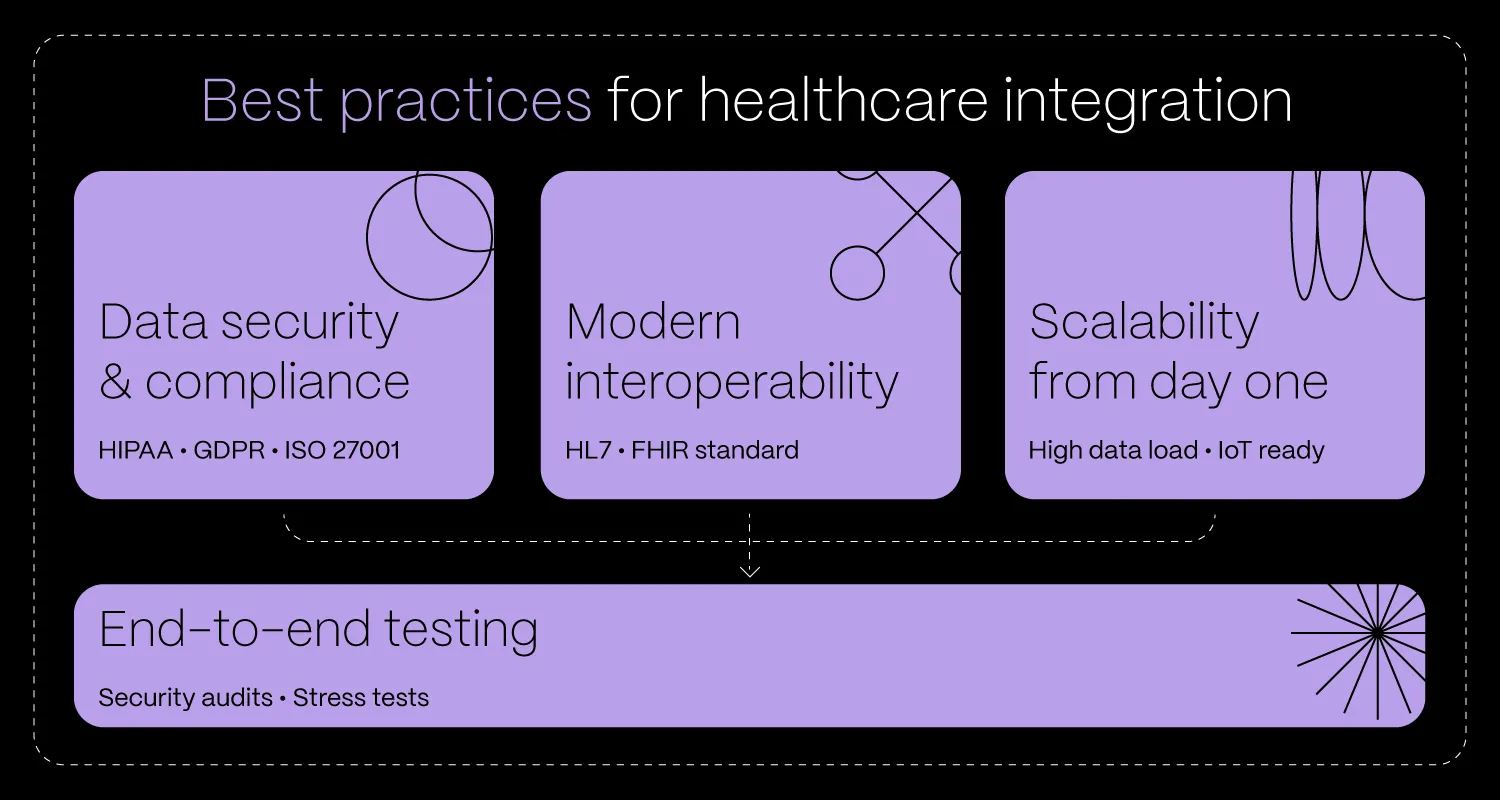
Connecting complex medical systems requires careful planning to avoid downtime and data leaks. Following the core steps in the system integration process ensures a smooth transition, reduced technical risks, and a highly secure infrastructure:
- Prioritise data security and regulatory compliance: Healthcare data is extremely sensitive. Always ensure your integration fully complies with industry standards like HIPAA, GDPR, and ISO 27001. As systems become more interconnected, properly managing and navigating patient consent in digital healthcare is essential to maintaining trust and protecting patient privacy.
- Adopt modern interoperability standards: Avoid rigid, custom-built shortcuts. Use widely accepted communication protocols such as HL7 and FHIR to guarantee seamless data exchange between legacy tools and modern applications.
- Plan for scalability from day one: Design your system architecture so it can handle growing volumes of patient data, new medical devices (IoT), and future software updates without crashing.
- Perform rigorous end-to-end testing: Thoroughly test the integration in a staging environment before going live. Run security audits, data migration tests, and stress tests to catch potential glitches early.
Tailored healthcare software integration services by Vega IT
Navigating the complexities of medical data, legacy platforms, and strict regulatory standards requires an experienced technical partner. At Vega IT, we provide custom healthcare software integration services designed to connect your disparate systems into a unified, high-performing digital ecosystem.
Whether you need to link your EHR with AI-powered diagnostics, build custom API connectors, or modernise legacy infrastructure, our engineering teams ensure seamless data flow, robust security, and full regulatory compliance from day one.
Transform your healthcare infrastructure today
Ready to eliminate data silos, reduce administrative overhead, and enhance patient outcomes?
Contact our healthcare tech experts today to discuss your integration project and discover how we can build a secure, scalable solution tailored to your organisation's needs.