Beyond testing: What quality engineering really means in safety-critical software

In many organisations, quality is still treated as a final checkpoint – a phase to catch bugs right before release. But in safety-critical software development, this traditional view of Quality Assurance (QA) is insufficient. True quality cannot be tested into a product after the fact; it must be engineered into the system from day one.
This marks the fundamental difference between traditional QA and Quality Engineering (QE). While QA typically asks, "Does this feature work as intended?", engineering for safety asks a fundamentally different question: "How do we design this system architecture and delivery process so it cannot fail, complies with strict industry regulations, and performs reliably under high load?"
This means designing for failure detection, containment, graceful degradation, and fail-safe behaviours. When software directly impacts human lives, health, or critical public infrastructure, quality becomes a core property of the system's architecture. It transitions from a best practice to an operational imperative.
Industry standards as engineering frameworks
Industry standards and regulatory requirements create the engineering discipline these systems demand. Quality Engineers operate at the intersection of architecture and compliance across several demanding sectors:
- HealthTech & MedTech (IEC 62304 / FDA standards): Connected medical devices and diagnostic platforms demand strict data integrity, cybersecurity, and deterministic reliability across the software lifecycle.
- Automotive (ISO 26262): Advanced Driver Assistance Systems (ADAS) and autonomous vehicle software require defined safety goals, rigorous hazard analysis, ASIL-related processes, timing constraints, and strict failure handling.
- Aerospace & Defence (DO-178C): Avionics software requires rigorous requirements, traceability and verification, with the depth of assurance activities determined by the applicable Design Assurance Level (DAL).
- Railway & Transport (EN 50128): Railway and signalling software must be engineered to support fail-safe behaviour under demanding real-world operating conditions.
Core practices: Building quality into the pipeline
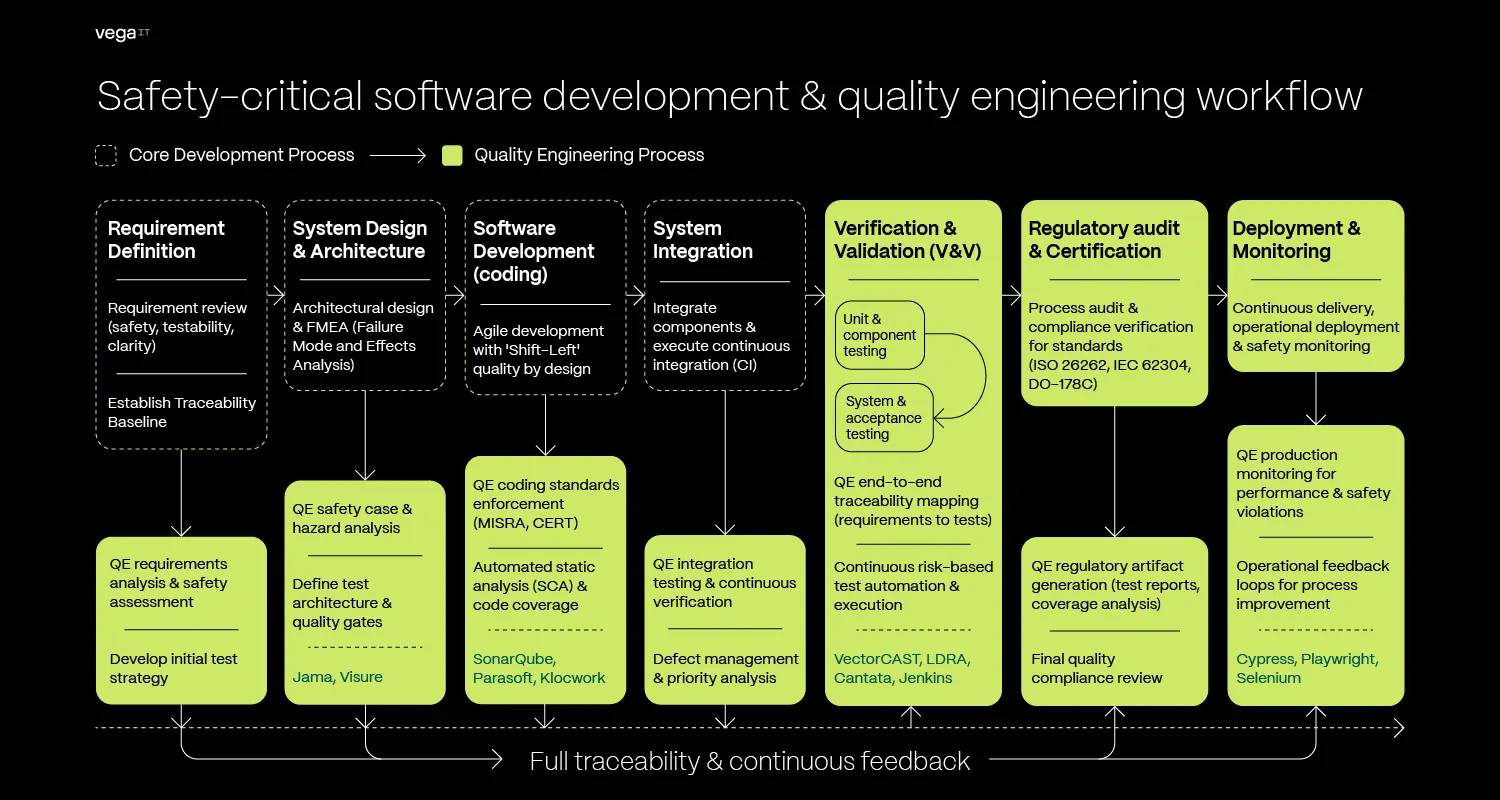
Meeting these standards without creating unnecessary delivery bottlenecks requires engineering practices embedded throughout the lifecycle:
- Quality by design & risk analysis: Teams use risk-analysis techniques such as Failure Mode and Effects Analysis (FMEA) and establish quality gates long before production code is written. By identifying risks at the architectural level, teams reduce the likelihood and impact of critical failures.
- Requirements-based traceability: Safety requirements need traceability across the development lifecycle, connecting requirements with relevant designs, implementation, verification activities, and test evidence. This turns much of the evidence needed for regulatory audits into a continuously maintained engineering output rather than an administrative exercise at the end of a project.
- Static analysis & standards compliance: Adherence to safe coding standards (such as MISRA C/C++ or CERT C) is enforced automatically. Static analysis tools are integrated into development workflows to identify potential defects, unsafe coding patterns, and standards violations before code reaches production.
- Automated HIL verification Hardware-in-the-Loop (HIL) pipelines allow teams to repeatedly validate hardware-software interactions against defined scenarios and edge cases, while reducing the time required for regression testing.
Regulation is expanding the definition of quality
The definition of quality is also expanding as new regulatory and cybersecurity requirements shape how safety-critical systems are developed and maintained.
AI-enabled systems
As the EU AI Act introduces additional requirements for high-risk AI systems, teams developing AI-enabled products need to incorporate compliance and assurance activities into the development lifecycle. Depending on the system and its classification, this can include requirements around risk management, data governance, transparency, human oversight, and ongoing monitoring.
Cybersecurity and functional safety
With mandates like UN R155/R156 and ISO/SAE 21434, quality engineering now includes verifying that security mechanisms—including secure boot and Over-the-Air (OTA) update processes—preserve functional safety throughout the software lifecycle. For example, resilient OTA architectures can support atomic updates and rollback mechanisms, helping prevent an interrupted or corrupted update from leaving a device in an unrecoverable state.
From compliance burden to engineering advantage
The commercial value of engineered quality is predictability.
In safety-critical environments, late defects do more than increase testing costs. They can trigger redesigns, delay certification, extend validation cycles, and push back market entry. Building quality into architecture and delivery processes moves these risks earlier, when they are easier and cheaper to address. When traceability, automated verification, and quality gates are part of the daily pipeline, compliance evidence becomes a natural byproduct of the engineering process, rather than an administrative burden.
This principle extends beyond software developed strictly for safety-critical systems. In regulated environments such as pharmaceuticals, for example, quality engineering means building validation, controlled change management, data isolation, and rollback mechanisms into the product architecture from the beginning. We applied exactly these principles when developing Axceler8 Rx, an AI-powered clinical trial management platform, ensuring strict data security and predictive reliability without slowing down delivery.
Engineered for reliability with Vega IT
For safety-critical software, quality is not a final checkpoint. It is an engineering property that has to be designed, verified, and maintained throughout the lifecycle.
At Vega IT, we apply these principles from the earliest stages of software engineering, helping organisations build reliable systems while navigating the technical, security, and regulatory demands of safety-critical environments.