The SaaSpocalypse aftermath: What eight months actually proved
In January, a software company's collapse in market value usually meant it had missed a quarter. This time it meant a competitor had shipped a product.
Anthropic released Claude Cowork and Claude Code. OpenAI released Frontier. Within days, public software markets had shed hundreds of billions of dollars, and by the end of February the figure across the sector was closer to two trillion. A Jefferies analyst gave it a name that stuck, and for most of the first quarter the SaaSpocalypse was the only story in enterprise software.
Eight months later, the index has largely recovered, yet the industry has not returned to normal. The stock market panic has settled, but the rules of the game have changed.
The three pillars of SaaS that quietly collapsed
The panic was not that software would stop being useful. It was that three assumptions underneath the SaaS business model had quietly expired:
The interface
SaaS was sold as a place where work happens, a screen a person logs into, navigates, and operates. If an employee can instead instruct an AI agent to pull data, produce reports and assign follow-ups, the application stops being a destination and becomes plumbing. Useful, but invisible, and priced accordingly.
The cost of building
Enterprise software was defensible partly because building an alternative was slow and expensive. Once AI made it dramatically cheaper to produce working software, incumbents were no longer facing a handful of well-funded competitors, but thousands of piranhas taking slices of functionality out of larger platforms.
At Vega IT, we're seeing the build-versus-buy calculation change in our own engineering workflows. Through agentic AI engineering, these agents can take on much of the repetitive structural work involved in development, making custom software more viable than it was before. But the important shift isn't that AI removes the complexity of enterprise software. It's that it changes where engineering effort is spent, from repetitive implementation towards architecture, business logic, security and quality.
The pricing model
Per-seat licensing assumes a stable relationship between headcount and value. It becomes impossible to defend the moment a customer automates the work those seats were paying for, or plans to hire fewer people next year.
None of this was invented in January. What the product launches did was convert a long-running theoretical discussion into a pricing question that boards and CFOs suddenly wanted answered.
Where did the SaaS budgets actually go?
SaaS budgets did not vanish; they were redirected from user licences into AI infrastructure, model usage, and internal build capacity.
We are actively watching clients navigate this exact budget reallocation on the ground. However, the shift isn't just about spinning up LLMs, it's about control. Enterprises are redirecting funds from SaaS bloat into building custom, AI-augmented internal capabilities. But in doing so, they are quickly realising a hard truth: autonomous systems require rigorous governance.
The new investment priority isn't just AI itself, but the engineering practices that orchestrate it, ensuring that security, data privacy, and architectural integrity aren't sacrificed in the rush for speed.
The market reaction was severe partly because the ground had already been prepared. Enterprises had spent years accumulating software, with the average large company running a portfolio of a few hundred applications and spending tens of millions of pounds annually. Most of these organisations entered 2026 already cutting projects and facing aggressive renewal increases. Procurement was tightening long before anyone even uttered the word ‘agent’.
When AI capabilities emerged, budget had to come from somewhere. The easiest line items for finance teams to challenge were naturally the ones where a business owner could not clearly articulate what a human ‘seat’ was actually buying.
By March, software as a category was trading at a lower multiple of forward earnings than the broader market for the first time since the cloud era began. Investors stopped paying a premium for recurring revenue and started asking whether that revenue would actually still recur in three years.
What happened after the SaaS panic ended?
The market stopped selling indiscriminately and started sorting vendors based on how their pricing models align with AI.
The software index bottomed in April and climbed through spring and summer, recovering most of its losses by September. But while the panic ended, the repricing did not. What replaced panic was something far more uncomfortable for individual vendors: a brutal sorting process.
Crucially, this sorting did not follow traditional growth rates. Companies growing at identical speeds ended up at opposite ends of the valuation table. Whatever the market was pricing, it was no longer simple momentum.
Which software business models will actually survive the SaaSpocalypse?
Three groups did well:
- Infrastructure providers: The first group sells infrastructure that AI consumes. Data platforms, observability tools, and communications infrastructure are paid by usage, and agent workloads generate more queries, more telemetry, and more traffic than human ones. For these companies, the disruption arrived as demand.
- Security vendors: The second is security, which had the cleanest version of the same argument. More automation means a larger attack surface, and a larger attack surface means more to defend. The thing threatening everyone else was the exact thing driving their growth.
- Adaptable incumbents: The third group is the more instructive one: large incumbents that were written off in February and recovered by August. Salesforce, whose chief executive dismissed the crash narrative as nonsense, came back once it could point to a substantial and separately identifiable AI revenue line rather than a strategy for building one. Atlassian recovered on similar evidence, including significant adoption of the interfaces that let AI agents work directly with its products instead of through its user interface.
The pattern is worth noting. Neither company was rewarded for announcing a transition. Both were rewarded months later, once the transition showed up as a disclosed number.
Salesforce also went through two versions of its AI pricing inside a year, having launched at a price point that enterprise procurement rejected before rebuilding the model around units customers were willing to buy. The most valuable pure-play software company in the world needed a second attempt. That is a reasonable expectation to set for everyone else.
Which software companies struggled, and why?
Software companies priced by the seat struggled most because AI compute increased cost of goods sold while user fees remained fixed.
The companies that lagged were, almost without exception, priced by the seat. Serving AI features to customers often made the product better but the margins worse, as AI compute behaved like cost of goods sold while the price per user stayed flat.
The real mechanism of the past eight months was very little software actually being replaced by agents in real-time. Instead, a great deal of software failed to justify a renewal increase to finance functions that had more compelling places to spend the money.
What does the SaaSpocalypse mean for the rest of us?
For buyers and builders of software, negotiating power has shifted towards custom capability over rigid per-seat licensing.
For organisations buying software, negotiating leverage remains unusually strong. Three questions are worth putting to every vendor at renewal:
- What happens to the bill when a meaningful share of users become automated processes?
- Can the product be operated programmatically without a person in the interface?
- Who controls the data and governance if the relationship ends?
For organisations building software, the unit on the invoice has become a strategic decision. Off-the-shelf SaaS is no longer the default when custom development can deliver exact capabilities without per-seat inflation. Shifting from buying SaaS to building tailored tools only works if development itself is drastically accelerated, allowing engineering teams to eliminate traditional friction while maintaining full control over governance and data.
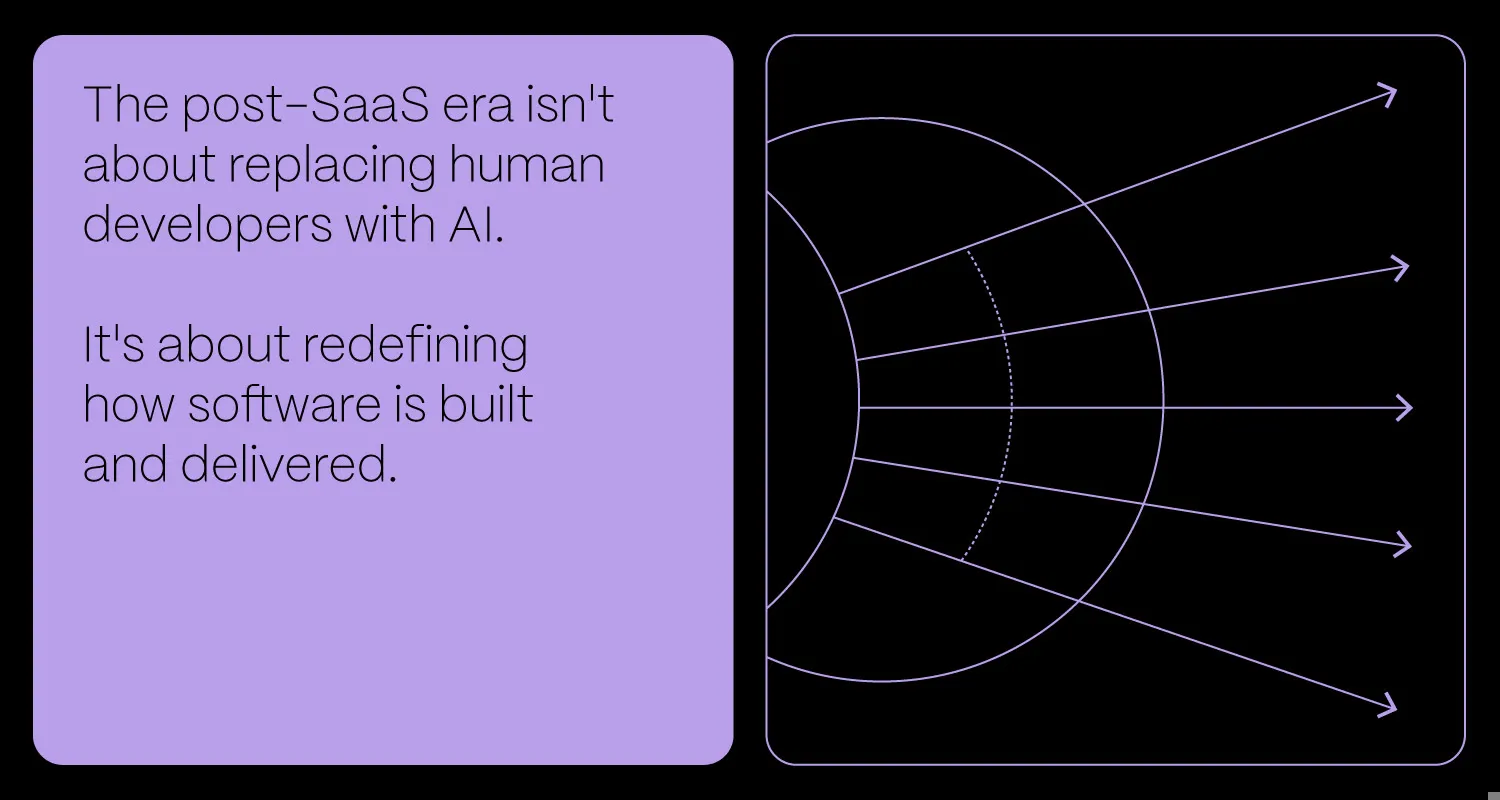
This market shift perfectly validates the industry's move toward agentic AI engineering. At Vega IT, we see firsthand that the post-SaaS era isn't about replacing human developers with AI; it's about redefining the delivery model. The organisations that will thrive are those that stop paying per-seat premiums for rigid platforms, and instead use AI to accelerate their own custom builds, applying agents for the heavy lifting, while focusing human engineering expertise on the critical architectural decisions that actually drive their business forward.