

What are AI agents and how can your business benefit from them?

Most organisations today have reporting tools, analytics platforms and automation workflows in place, yet they often struggle with coordination across systems and teams.
Insights are generated, dashboards are reviewed and decisions are discussed, but moving from analysis to execution still requires manual effort. Someone has to retrieve information from multiple platforms, align stakeholders and trigger the next step.
This persistent gap between insight and action is where AI agents are starting to make a measurable difference.
Artificial intelligence is no longer limited to producing outputs. Increasingly, it is being designed to operate within business processes, pursue defined objectives and execute tasks across connected systems.
AI agents explained: From response to execution
To understand the shift, it helps to examine how most AI systems are used today. They are primarily prompt-driven: a user asks a question, and the model generates a response based on available context.
An intelligent agent in AI operates differently. It begins with an objective and determines how to achieve it.
Here's a common business scenario. A leadership team wants to understand declining margins in a specific region. A traditional AI tool might summarise existing reports. An AI agent, by contrast, could retrieve financial and operational data from multiple systems, compare performance against targets, identify potential drivers and escalate findings to the relevant department for review. The difference lies not in analysis alone, but in coordinated execution.
This capability is often described as agentic AI – systems that combine reasoning, planning, memory and controlled tool access to pursue defined outcomes.
In business environments, AI agents are therefore less about conversation and more about operational alignment. They reduce the invisible coordination work that typically slows complex workflows.

Digital transformation: How agentic AI is redefining enterprise growth
The real value of agentic AI lies in its ability to drive autonomous decision-making, but businesses must capture that value with clear guardrails to manage risk.
Read full articleHow AI agents work in enterprise environments
AI agents rely on several core capabilities that allow them to operate within business processes rather than alongside them:
- Reasoning models that interpret business objectives and determine next steps based on context, not just prompts.
- Contextual memory that tracks prior decisions, constraints and outcomes, enabling continuity across workflows.
- Controlled tool access to APIs, databases and internal systems, governed by defined permissions and action boundaries.
- Multi-step planning and execution, allowing the agent to break down objectives, retrieve missing information and act iteratively.
In practice, this follows a structured loop. A business goal is defined, the AI agent decomposes it into tasks, gathers the necessary data and executes actions within its authorised scope. Where required, it escalates decisions for human approval before proceeding.
In enterprise environments, this often means interacting with CRM platforms, ERP systems, analytics tools and internal applications through structured APIs. The value of AI agents lies not in replacing these systems, but in embedding reasoning directly into operational workflows.
This ability to connect analysis and execution within a single loop is why AI agents are becoming central to modern AI and automation strategies.
AI agents in business: Where real value emerges
Most organisations struggle with operational fragmentation. Teams work across disconnected systems, processes rely on manual coordination and decision-making is slowed by data silos.
AI agents in business address these structural inefficiencies in three important ways.
First, they reduce operational drag by coordinating workflows across multiple systems. Instead of employees manually checking a CRM, updating a spreadsheet and notifying finance, an AI agent can retrieve the relevant data, validate it against policy rules and trigger the next step automatically.
Second, they compress the time between analysis and execution. In many organisations, insights sit in dashboards waiting for someone to act on them. When reasoning and execution exist in the same loop, actions can be triggered immediately, whether that means escalating a risk case or adjusting a supply order.
Third, they extend automation beyond fixed, rule-based logic. Traditional automation works well for predictable processes. Agentic AI systems can handle variability, incomplete data and multi-step objectives without requiring every exception to be pre-programmed.
This is where AI agents move beyond simple task automation. They enable goal-oriented automation – automating outcomes rather than isolated steps.
AI agents examples across industries
AI agents examples are already emerging across regulated and operationally complex industries.
In healthcare, agentic AI systems are being used to coordinate patient records, generate structured clinical summaries and reduce administrative overhead that typically consumes clinical time.
In banking and insurance, AI agents are evolving beyond anomaly detection. Rather than simply flagging irregular transactions, an agent can compile supporting documentation, assess regulatory thresholds and prepare a draft compliance summary before escalating the case for human judgement, shortening response cycles while maintaining control.
In retail and supply chain environments, AI agents can connect demand forecasting with procurement workflows, triggering replenishment or pricing adjustments automatically rather than waiting for manual intervention.
Internally, organisations are deploying AI agents to streamline procurement approvals, onboarding workflows and IT service management – areas where fragmented systems often slow execution more than strategy does.
Across industries, the pattern is consistent: AI agents deliver the greatest value where workflows cross system boundaries and require both reasoning and action.

Agentic AI use cases: How autonomous AI agents are reshaping business operations
For a broader overview of practical applications, explore our detailed guide on agentic AI use cases across industries.
Read full articleAgentic AI implementation: a strategic approach
Implementing AI agents requires more than technical integration. Unlike traditional automation, agentic AI introduces varying degrees of autonomy, which must be carefully aligned with business risk tolerance.
Successful agentic AI implementation begins with a clearly defined objective. Rather than attempting to automate entire departments, organisations should focus on a specific workflow where decision latency or coordination overhead creates measurable inefficiency.
Integration design is equally important. AI agents require structured access to data sources, clearly scoped permissions and well-defined action boundaries. Without explicit constraints on what an agent can trigger – whether sending communications, updating records or initiating financial transactions – autonomy can quickly introduce unintended consequences.
Governance must extend beyond system monitoring. Organisations should define escalation logic, approval thresholds and audit trails that make agent decisions transparent and reviewable. Observability is critical: if an agent acts, the organisation must be able to understand why.
For organisations exploring how to create AI agents, long-term success depends on maintaining a deliberate balance between capability and control, enabling autonomy where it drives efficiency, and retaining human oversight where risk demands judgement.
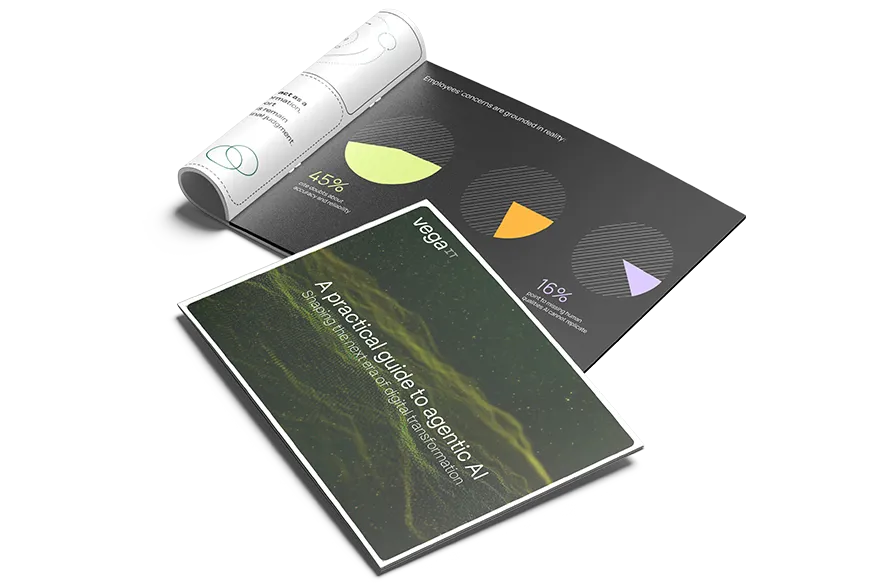
A practical roadmap for agentic AI in your business (e-book)
For organisations ready to move from strategy to execution, we have outlined a structured roadmap for agentic AI adoption in our practical implementation guide.
Download free ebookRisks and considerations
AI agents introduce new opportunities, but also new responsibilities.
Because agentic AI systems can plan and act across multiple tools, poorly defined permissions or unclear decision boundaries can lead to unintended actions at scale. In multi-agent environments, coordination errors can propagate quickly if escalation logic and observability are not clearly defined.
Governance therefore becomes more than a compliance requirement. It is an operational necessity. Organisations must be able to trace what an AI agent did, why it acted and under which constraints.
These risks do not diminish the value of AI agents. They underline a simple principle: autonomy must be proportional to control.
As with earlier waves of cloud and automation, competitive advantage does not come from deploying advanced technology first, but from embedding it within disciplined operational frameworks.
The future of AI agents in business
The conversation around artificial intelligence is evolving. The question is no longer whether AI can generate useful outputs, but whether it can operate reliably within core business processes.
AI agents mark a structural shift from assistance to execution. They allow organisations to automate objectives, not just isolated tasks, embedding reasoning directly into operational workflows.
For businesses managing increasing system complexity and decision pressure, this shift is not theoretical. It determines how quickly insight turns into action, how consistently policies are applied and how effectively teams coordinate across fragmented environments.
When deployed responsibly, AI agents can reduce coordination overhead, shorten response cycles and create more resilient operational models.
Understanding what AI agents are is only the starting point. The real advantage comes from deliberately designing where, and to what degree, they should act within your organisation.