

Agentic AI use cases: How autonomous AI agents are reshaping business operations

Agentic AI is steadily moving from research labs into real business environments. While generative AI has captured widespread attention by producing text, images, and code, agentic AI is changing something far more fundamental: how work actually gets done.
Agentic AI does not wait for prompts, it is designed to act with intent. These systems can understand goals, make decisions, and carry out complex sequences of actions across multiple systems, often without continuous human input. In practice, this means AI agents can take ownership of outcomes, not just support individual tasks.
Agentic AI is particularly powerful because of its ability to operate across entire workflows rather than within isolated steps. Instead of assisting a user at a single point in time, an AI agent can pursue a goal end to end, adjusting its behaviour as conditions change and new information emerges.
From generative AI to agentic AI
The difference between generative and agentic AI is not just technical; it is practical. Generative AI responds. Agentic AI acts.
A generative model might draft an email, summarise a document, or generate code when prompted. An agentic system, on the other hand, can decide when an email should be sent, gather the necessary context from multiple systems, generate the message, follow up if no response is received, and update internal records once the task is completed.
This shift explains why agentic AI is increasingly viewed as the next phase of enterprise AI adoption. Rather than producing outputs in isolation, agentic systems coordinate tools, data, and models to deliver outcomes that matter to the business.
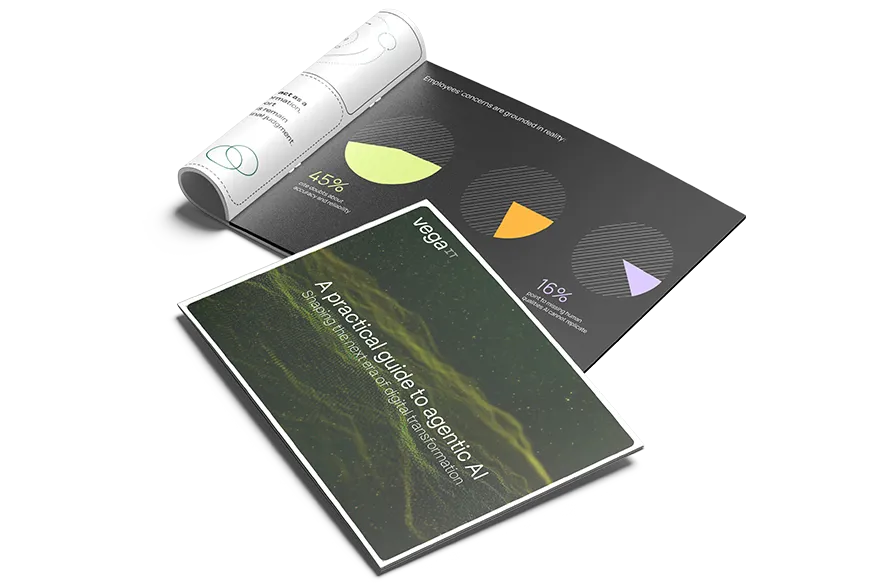
A practical roadmap for agentic AI in your business
This e-book will guide you through the journey from AI strategy to tangible business outcomes.
Download hereAgentic AI use cases in business operations
One of the most mature areas for agentic AI adoption is business operations. Large organisations typically operate across fragmented systems – ERP, CRM, data warehouses, supply chain platforms – where decisions depend on constantly changing signals. Agentic AI agents are well suited to this environment because they can observe, reason, and act across systems in real time.
In practice, an operations-focused AI agent might monitor performance metrics, detect emerging risks, investigate root causes by querying multiple data sources, and initiate corrective actions. Instead of simply flagging issues, the agent can recommend or execute responses, escalating to human teams only when judgement or approval is required.
Over time, these agents learn which interventions produce the best outcomes and refine their strategies accordingly.
This ability to manage end-to-end operational workflows is why business operations AI agents are increasingly seen as a step beyond brittle automation and rule-based systems.
Agentic AI in healthcare: Coordination at scale
Healthcare presents a uniquely complex environment for AI. Long clinical workflows, fragmented data, and strict regulatory requirements directly translate into high operational costs and delayed outcomes. Agentic AI is gaining traction in healthcare because it addresses these challenges at the workflow level, coordinating processes end to end rather than optimising isolated tasks.
In clinical trials, AI agents are being used to improve recruitment efficiency, reduce protocol deviations, and shorten trial timelines by continuously monitoring progress and intervening early when risks emerge. Instead of relying on manual oversight, agents allow teams to focus on high-value decisions while routine coordination is handled autonomously.
Similar agentic approaches are emerging in hospital operations, where AI agents support patient flow and resource allocation, thus helping organisations reduce bottlenecks, improve utilisation rates, and maintain compliance without increasing administrative burden.
Research published in npj Digital Medicine indicates that agent-based AI systems can deliver these operational gains while preserving transparency, auditability, and governance which make key requirements for scaling AI in healthcare environments.

Agentic AI in healthcare
Healthcare is no longer constrained by a lack of technology, but by the way decisions and actions are fragmented across systems.
Learn moreAgentic AI in insurance: From process acceleration to decision quality
Insurance operations are defined by complex, multi-step workflows where speed, accuracy, and compliance directly affect both cost ratios and customer experience. Agentic AI is gaining traction in insurance because it can take ownership of these workflows end to end, rather than accelerating individual steps in isolation.
In claims management, AI agents are increasingly used to reduce cycle times and operational costs by coordinating document ingestion, coverage validation, risk assessment, and follow-up actions within a single workflow. Instead of pushing cases through manual hand-offs, agents continuously evaluate context, identify missing information, and route claims to the appropriate resolution path. This allows human teams to focus on exceptions and high-risk cases, where judgement and expertise add the most value.
The business value lies not only in efficiency gains, but also in improved decision quality and auditability. By maintaining clear reasoning paths and detailed action logs, agentic AI systems support compliance and governance, critical factors for scaling automation in highly regulated insurance environments.
AI agents versus chatbots in customer-facing workflows
Agentic AI is often confused with advanced chatbots, but the difference becomes clear in customer-facing use cases. Chatbots respond to questions. AI agents execute tasks.
In sales and customer service environments, agentic systems can manage interactions across channels, gather context from CRM systems, personalise responses, schedule follow-ups, and update records automatically. While the user experience feels conversational, the underlying system is orchestrating a multi-step workflow that would otherwise require significant human coordination.
This is why comparisons such as “AI agent vs chatbot” are becoming increasingly relevant as organisations assess how far they want to automate customer engagement.

Stay in the loop. Subscribe to our newsletter!
Get stories, insights, and ideas that shape the digital world, straight from our team.
Sign up hereThe role of AI agent frameworks
Most real-world agentic AI use cases are built on top of specialised AI agent frameworks. These frameworks provide the foundation for memory, planning, tool usage, and coordination across systems and agents.
Rather than hard-coding workflows, organisations rely on agentic AI frameworks to build adaptable systems that can evolve as business requirements change. This flexibility is critical as agentic AI moves from experimentation into production, particularly in complex enterprise environments.
Where agentic AI is heading next
Agentic AI is still in its early stages, but its trajectory is clear. As frameworks mature and governance practices improve, AI agents will increasingly take responsibility for cross-functional workflows that span departments and systems. Instead of replacing people, these agents will reduce coordination overhead and allow human teams to focus on strategy, creativity, and oversight.
For organisations already experimenting with generative AI, agentic AI represents the next logical step: moving from AI that produces content to AI that delivers outcomes.