AI is not just changing jobs but also how expertise is defined
The true AI revolution in the workplace is not about automating tasks, but about how technology redraws the line between automated efficiency and irreplaceable human judgment.
In a previous article, AI at work: where automation ends and judgment begins, we explored a growing reality inside modern organisations, which is that the real value of artificial intelligence is not full automation, but collaboration between humans and intelligent systems.
AI evolves on a daily basis and is constantly changing. With that pace of change, we must constantly assure accuracy and relevance. However, human adaptation rarely moves at the same speed as technological advancement.
Selective resistance and the crisis of identity
Technology moves fast, and humans adapt slowly. Resistance increases as tasks become more judgment-based or identity-based. In other words, people accept automation when it removes friction and resist it when it threatens competence, identity, or status.
This is supported by global data from the Microsoft Work Trend Index, which reveals that while 70% of workers would happily delegate administrative tasks to AI, 64% simultaneously struggle with the lack of clear boundaries regarding where human judgment should remain absolute.
People want intelligent tools as a teammate, not as a replacement for human value. Precisely because of that, leaders frequently interpret hesitation as resistance to the technology itself. In reality, the emotional response is tied to uncertainty, loss of control, and a fear of becoming less relevant.
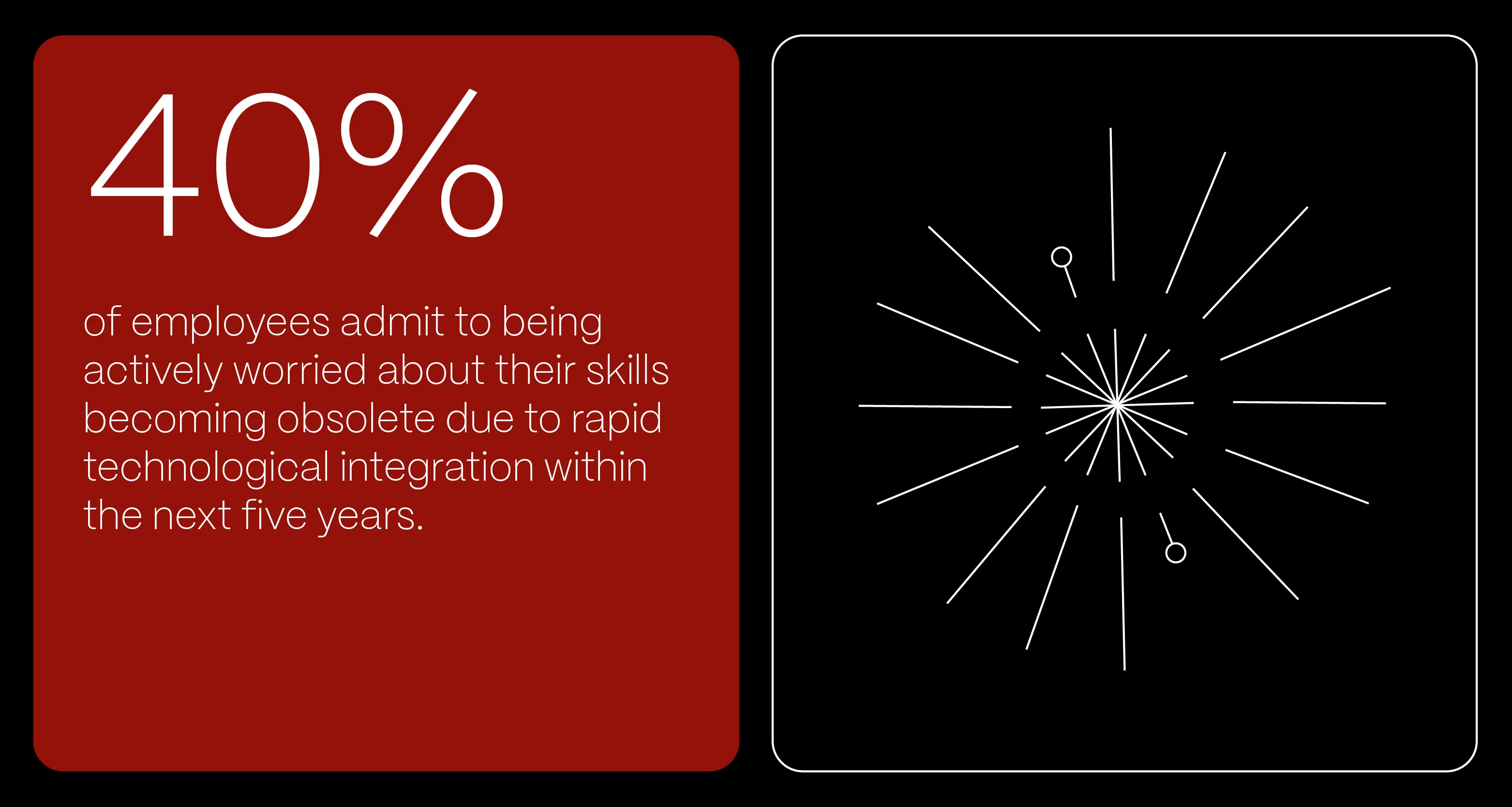
According to the comprehensive PwC Global Workforce Hopes and Fears Survey, 40% of employees admit to being actively worried about their skills becoming obsolete due to rapid technological integration within the next five years. When new tools are introduced, employees evaluate what the technology means for them personally, whether their role will still matter, what happens to the skills they spent years building, and how they stay valuable.
Consider the example of a senior graphic designer who has spent a decade mastering complex software, colour theory, and precise visual execution. When an AI tool can generate comparable visual assets in seconds, the designer experiences a profound disruption. The resistance that follows is rarely about the software itself, but about the sudden erasure of the technical mastery that defined their professional worth.
People do not resist change simply because it is new. They resist environments where they no longer understand how their contribution creates value.
Learning compression and the redefinition of seniority
Historically, expertise was strongly associated with accumulated knowledge and operational mastery. Senior professionals became valuable because they knew more, remembered more, and executed more effectively than less experienced colleagues. Today, access to information is no longer the differentiator it once was, as technology can retrieve, organise, and summarise vast amounts of data faster than any individual.
Technology compresses the traditional career progression. Less experienced employees can now complete tasks that previously required years of accumulated operational knowledge, making research, analysis, drafting, and technical implementation highly accessible. Interestingly, landmark research published by the National Bureau of Economic Research (NBER), conducted by researchers at Stanford and MIT, has shown that AI support tends to improve the performance of less experienced workers more significantly than that of highly experienced professionals, boosting the productivity of the lowest-skilled workers by up to 34%.
This shift does not eliminate the value of seniority, but it changes where seniority creates value.
In modern organisations, seniority becomes less about having all the answers and more about knowing which answers can be trusted. Experienced professionals bring immense value through high-level decision-making and long-term strategy, areas where AI cannot replicate human judgment.
A prominent study by Harvard Business School and Boston Consulting Group (BCG) demonstrated that when professionals rely on AI blindly for complex, strategic problem-solving without senior analytical filters, the correctness of their decisions actually drops by 19%.
Senior leaders are essential for navigating ambiguity, aligning operational outputs with business objectives, identifying systemic risks, and managing complex stakeholder relationships. Consequently, senior professionals increasingly become responsible for strategic direction, critical decision-making under pressure, contextual interpretation, risk assessment, governance, and mentoring.
Cultural transformation over management control
Because workflows, tools, and responsibilities evolve continuously, learning can no longer exist separately from day-to-day work as a periodic training initiative or a one-time upskilling effort. Adaptability has become part of operational survival. Employees increasingly need to constantly learn new tools, collaborate with intelligent systems effectively, validate outputs critically, and interpret complexity.
This continuous pressure means that successful adoption is rarely just a technology challenge; it is a cultural one. Companies cannot expect people to adapt successfully while operating in environments built around fear, control, or constant performance anxiety. According to a global study by McKinsey on AI adoption, 71% of organisations that successfully capture value from AI state that success depends on reshaping company culture, leadership development, and strategic alignment rather than technology infrastructure alone. Organisations need to move away from management models built entirely around oversight and control.
As technology integration makes workflows more interconnected and decision-making more distributed, modern environments depend far more on transparency, trust, adaptability, shared responsibility, and human judgment.
Where Vega IT steps in as your AI transformation partner
AI transformation is rarely successful when companies approach it purely as a tooling initiative. Implementing AI without helping people adapt usually creates more uncertainty than progress.
Organisations need support not only in introducing new technologies, but in redesigning workflows, redefining responsibilities, and helping employees understand where human contribution continues to create value.
That requires a combination of technical expertise, industry understanding, and organisational awareness.
We help organisations approach AI transformation more strategically – not by replacing people with technology, but by identifying where AI can reduce operational burden while allowing teams to focus on higher-value work.
In practice, that often means:
- automating repetitive and time-consuming processes,
- improving access to structured data and insights,
- supporting better decision-making,
- and creating systems where AI enhances human capabilities rather than competes with them.
Successful transformation also depends on building trust, introducing change gradually, and helping teams develop the confidence to work effectively alongside AI systems. The organisations that move through this transition most successfully are usually the ones that treat AI adoption as both a technological and human transformation.